The construction and real estate industries are changing fast. Projects are becoming more complex, costs are harder to control, and clients expect better results with fewer delays. At the same time, businesses must manage teams, materials, budgets, suppliers, and customers across multiple locations.
Construction ERP software brings key business functions together, helping companies manage operations with better visibility and control. At Quadra, we understand that construction and real estate businesses need more than basic record-keeping. They need connected systems that support day-to-day decisions and long-term growth.
1. Using AI and Predictive Analytics for Better Decision-Making
Construction projects always have a number of uncertainties. The price of the materials can be changed, equipment can fail, and unforeseen delays will also have an impact on the budget. AI and predictive analytics help businesses spot possible problems before they occur.
Modern ERP systems are already shifting from reviewing past reports to analysing data and spotting possible risks in it. This can be useful in forecasting costs, planning resources, and making informed decisions.
2. AI-Driven and Agentic ERP Systems
AI can bring changes to how businesses operate their ERP systems as well. AI-driven tools can automate such processes as document creation, data analysis, and tests. It can help in reducing the amount of routine tasks, and speed up some activities.
The next step in evolution is an agentic ERP where AI agents can do defined tasks interacting with business data and using defined rules.
3. Cloud-Based ERP for Growing Businesses
When information is isolated in different systems, it can be difficult to manage multiple projects from multiple locations. Addressing this issue, cloud-based ERP software puts business information in a single place while granting users access rights, depending on their connection and security status.
Teams can obtain information that is relevant without having to depend on one office or local system. Additionally, by optimizing software updates, providing easier management, and avoiding the need for a large onsite IT infrastructure, cloud deployment can also help lower costs.
Quadra ERP provides construction, contracting and real estate businesses a single integrated platform that manages project management, procurement, finance, inventory, HR and CRM. The multi-company, multi-currency and multi-language capabilities are helpful to firms which have business operations in various countries and regions.
4. Accessibility for On-Site Teams on Mobile Devices.
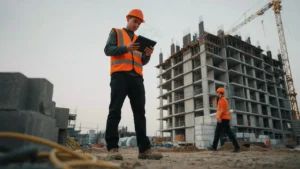
Buildings are not the only places where construction takes place. Information is required on site by site engineers, supervisors, project managers and procurement.
Mobile access enables teams to share updates and access relevant project information without having to get to their desk. Mobile tools may facilitate progress tracking, reporting, inventory, and communication between site and office teams, based on the system.
5. Efficient Integration of BIM and IoT for increased project visibility.
The Internet of Things (IoT) and Building Information Modeling (BIM) are offering new ways to understand construction projects and manage buildings. BIM is a digital representation of buildings and their elements. IoT devices gather data from other assets, sensors, and connected devices. Together with appropriate business systems, they can be used to assist in planning, monitoring and maintenance.
ERP integration can help connect this information with business activities such as procurement, budgeting, and asset-related planning. The exact benefits depend on system compatibility and implementation.
6. Sustainability and ESG Reporting Become More Important
Construction firms and property developers are increasingly taking sustainability into account. As a trend, businesses are under increasing pressure to learn about their energy use, material use, waste, emissions and environmental performance.
An ERP system can assist with this by centralizing pertinent financial, purchasing, inventory, and operational data. Through appropriate data collection and reporting systems, companies can follow specific sustainability indicators and provide more uniform reporting.
7. Connected Data and Stronger Information Security
Construction and real estate businesses handle sensitive data, including budgets, contracts, supplier details, employee records, and client information. When this data is scattered across different systems, finding the right information and maintaining control over it becomes difficult.
The idea behind an ERP system is to integrate business data in a manner where access to it is controlled through the specific rights and levels of access provided to specific users. The greater level of integration means that duplication of data is less likely and hence more accuracy in reports and data consistency across various departments.
The question of security is equally significant. User permissions, access control, data security, backup systems, and other things form the security infrastructure of any business, which needs to be properly configured. The integration issue is also a very crucial factor here.
How Quadra ERP Helps Construction and Real Estate Businesses
These trends point towards one important change: construction and real estate businesses need better connections between their people, projects, and information.
Quadra ERP combines a wide range of capabilities, including project management, estimating, purchasing, accounting, human resources, inventory management, and customer relationship management, into one system. This helps organizations close the gap between information and coordination within the organization.
The capability to deal with multiple corporations, currencies, and languages can help enterprises manage their operations at different locations.